Extreme weather can leave $43 million gap in local economies through lasting small business impacts
The economic impacts of a natural disaster on small businesses can continue to be felt for years after the event itself, according to new research released by QBE.
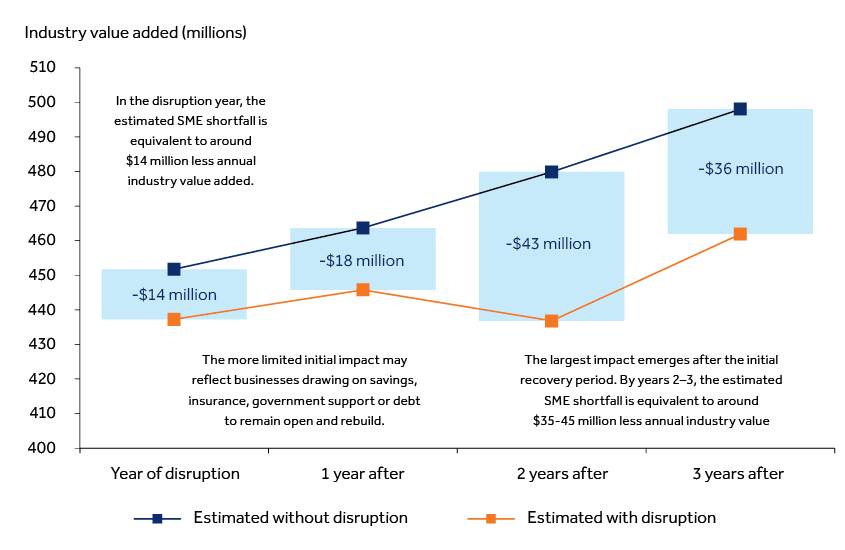
QBE’s report The Recovery Gap reveals that two years after a severe weather event, affected communities had nearly 10% fewer small businesses than they would have had without the disaster, representing around $43 million in annual economic activity that is never realised.
The research shows that rather than fading over time, the economic impacts of severe weather can deepen, creating a widening “recovery gap” between where a community ends up and where it otherwise would have been without the disaster.
Commissioned by QBE and conducted by Oxford Economics Australia, the research analysed seven major Australian bushfires, floods and cyclones between 2018 and 2023, comparing affected communities with similar regions that were not impacted by a major event. As a major insurer of Australian small businesses, QBE sees firsthand the role they play in local communities and the challenges they face recovering from major disruption.
The research showed that the recovery gap widened over time. In the year of a disaster, affected communities had around 3% fewer businesses than they otherwise would have had the event not occurred. One year later, the gap had grown to around 4%, before reaching 9% two years after the event.
The delayed impact may reflect businesses drawing on insurance payments, savings, government assistance or additional debt to remain operational in the immediate aftermath, with the full impacts only becoming visible after these resources have been exhausted.
While the recovery gap begins to stabilise in the third year, affected communities remain below their expected growth trajectory, with 7% fewer businesses than expected and an associated $36 million gap in annual economic activity. This suggests major disruptions may leave permanent ‘economic scarring’.
For communities, fewer businesses can mean fewer local jobs, reduced demand for suppliers, lower spending and fewer services available to residents.
The impacts were even more pronounced following the most severe events analysed, with affected communities estimated to have 21% fewer businesses than they would have otherwise had two years after the disruption.1
Importantly, the research found a strong link between resilience and recovery. Two years after a major disruption, lower-resilience communities were supporting around 15% fewer small businesses than expected, while those with higher resilience remained broadly unaffected.
Factors contributing to stronger community resilience include disaster preparedness, reliable infrastructure, strong local employment and business activity, access to essential services and strong community connections.
Businesses can also influence their own recovery trajectory. Measures such as business continuity planning, regular maintenance, protecting critical assets, and identifying vulnerabilities can help minimise disruption and support a quicker return to trading.
Other key findings
- Regional communities experienced more than 2x the decline in small business numbers of capital cities 2-3 years after disruption.
- Small businesses employing 1-19 people were 12% below expected levels three years after disruption.
- Industrial sector businesses – such as those in agriculture, mining, manufacturing, utilities and construction – recorded the largest long-term impacts, with nearly 10% fewer businesses two to three years after disruption.
- QBE claims data2 from 17 significant weather events in 2025 found the average small business claim was approx. $30,000.
“Recovery is often measured by what has been rebuilt. This research highlights another side of the story: the businesses that never reopen, the opportunities that never emerge, and the growth that never occurs.
“Severe weather doesn’t just affect what a community has today. It can change what that community becomes tomorrow. Every small business lost can mean fewer jobs, fewer services, less investment and fewer opportunities. When those losses accumulate, they can alter the economic future of an entire community.
“The findings show that long-term outcomes are not predetermined. Communities that were better equipped to withstand disruption retained significantly more businesses in the years that followed, highlighting the role preparation can play in shaping recovery.
“As QBE marks 140 years of supporting Australian businesses and communities, we’ve seen firsthand the role resilience plays in helping people navigate uncertainty and recover from adversity. While insurers have an important role to play, building resilience is a shared responsibility. Governments, industry, communities and businesses all have a role in helping communities recover and thrive after major disruption.
“For businesses, resilience starts with understanding your risks and embedding preparedness into day-to-day operations. It can mean the difference between a temporary setback and a lasting economic scar.”
1 The high and very high severity events were selected based on the distribution of losses per person within the disaster data base. High severity events refer to those with insurance losses per person in the 4th quintile of the distribution ($550-$1,650 per person). Very high severity events refer to those with insurance losses per person in the 5th quintile of the distribution ($1,650+ per person).
2 QBE catastrophe claims data relating to 17 catastrophe events between January and December 2025 (Business Package property claims only).