The Recovery Gap: Understanding the long-term impact of disruption on Australian businesses
When a major disruption strikes, the visible impacts are often only part of the story. New research commissioned by QBE and conducted by Oxford Economics Australia reveals that the effects can continue long after recovery begins, slowing business growth and leaving communities with fewer businesses than they otherwise would have. The findings highlight the importance of resilience and preparedness in supporting stronger recovery outcomes.
When a major disruption strikes, the immediate impacts are often the most visible. Damaged property, interrupted operations, supply chain delays and lost trading days can place significant pressure on businesses and their communities.
What is less visible is the impact that disruption can have in the years that follow.
New research commissioned by QBE and conducted by Oxford Economics Australia suggests the effects of major disruptions can persist long after clean-up and rebuilding efforts begin. By analysing seven significant Australian bushfires, floods and cyclones between 2018 and 2023, the research examined how small and medium-sized enterprises (SMEs) in affected communities performed compared with similar regions that did not experience a major disruption.
The findings reveal a “recovery gap” that can leave communities with fewer businesses, lower economic activity and slower growth for years after a major event.
The true cost of disruption
The research found that the greatest impact of disruption is not always immediate.
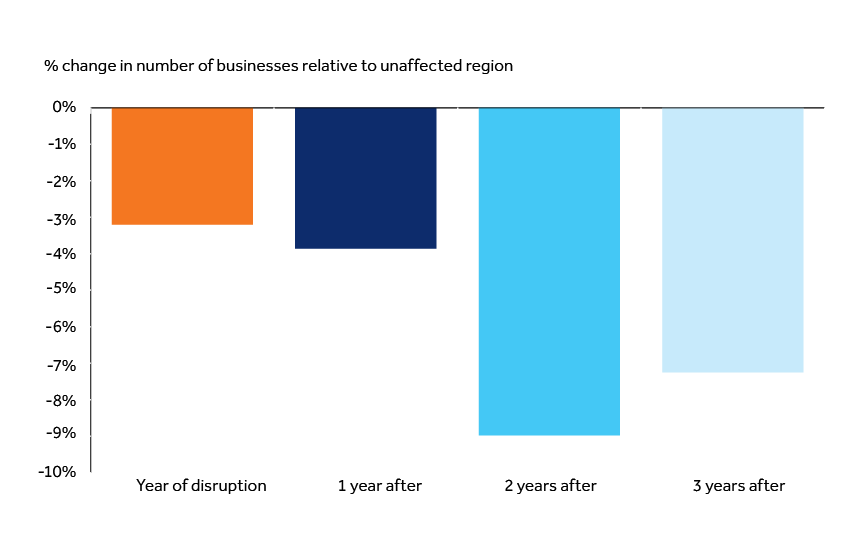
In the year a major disruption occurs, SME numbers in affected regions were estimated to be around 3% lower than they otherwise would have been. One year later, the gap widened to 4%. The largest impact emerged after two years, when business numbers were estimated to be 9% below expected levels. Even after three years, affected communities remained around 7% below the growth path they were likely to have followed without the disruption.
Importantly, this does not necessarily mean businesses disappear overnight. Rather, disruption can slow business formation, delay investment and make recovery more challenging, leaving communities with fewer businesses than they otherwise would have supported. On average, affected regions were estimated to have around 100 fewer SMEs than expected three years after a major disruption.
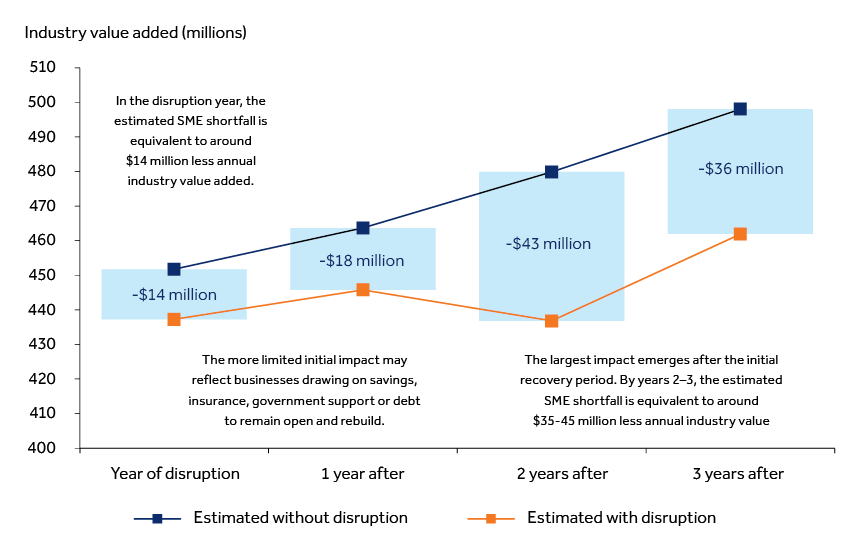
The economic implications are significant. According to the analysis, the smaller business base is equivalent to approximately $43 million less annual economic activity for the average affected region two years after a major disruption.
Regional communities face a steeper road to recovery
While disruption affects businesses across Australia, regional communities were found to experience larger and more persistent impacts.
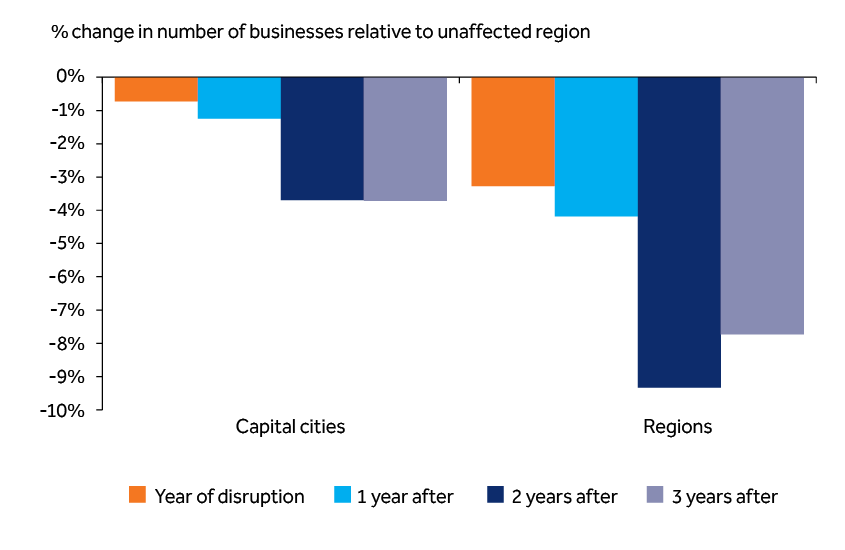
Two years after a major disruption, regional business numbers were around 9% below expected levels, compared with less than 4% in capital cities. This means regional communities experienced more than twice the decline in business numbers seen in metropolitan areas.
The findings reflect the unique characteristics of many regional economies. Regional communities often rely on a smaller number of industries, closely connected supply chains and critical transport links. When roads are damaged, freight routes are disrupted or a major local employer is affected, the impacts can flow through the wider local economy.
By contrast, businesses in capital cities generally have access to larger customer bases, broader supplier networks and more alternative routes to market, helping to soften some of these flow-on effects.
Small businesses are particularly exposed
The research also found that smaller employers face greater challenges recovering from disruption.
Businesses employing between one and 19 people were estimated to be 5% below expected levels one year after a major disruption, with the gap widening to 12% after three years. Fixed costs such as wages, rent and utilities continue even when revenue slows, making it harder for smaller businesses to absorb prolonged periods of uncertainty.
This highlights the importance of planning ahead and understanding potential vulnerabilities before they affect business operations.
Resilience makes a measurable difference
One of the report's strongest findings is the relationship between resilience and recovery.
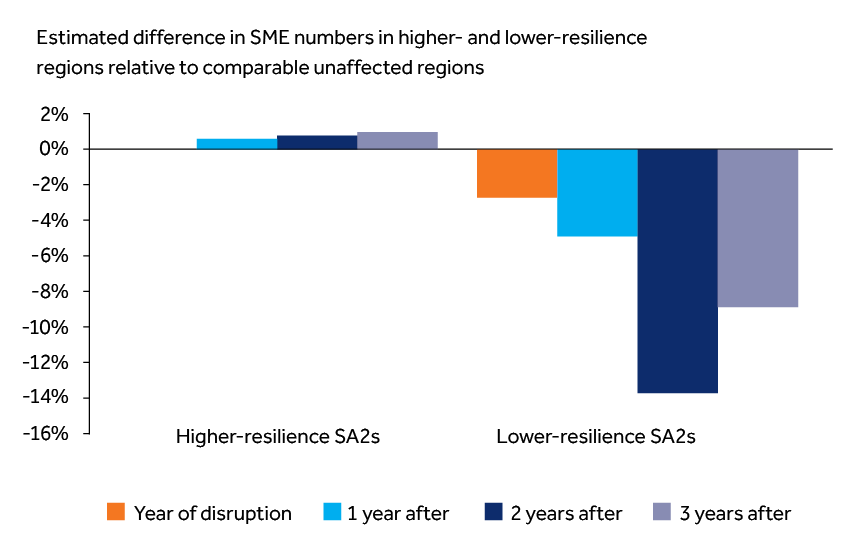
Communities with higher levels of disaster resilience experienced significantly smaller impacts than those with lower resilience. Areas with stronger resilience capacity were largely unaffected by disruption, while lower-resilience communities experienced sustained declines in SME numbers over several years.
The research suggests factors such as disaster preparedness, reliable infrastructure, strong local economic activity, access to essential services and community connections can all contribute to stronger resilience outcomes.
For businesses, resilience may involve business continuity planning, reviewing operational dependencies, assessing supply chain risks and ensuring recovery plans are regularly maintained and tested. While disruption cannot always be avoided, preparation can help businesses adapt, respond and recover more effectively when challenges arise.
Building stronger businesses and communities
As Australian businesses navigate an increasingly complex risk environment, the findings reinforce an important message: recovery does not end when the clean-up does.
The long-term effects of disruption can persist for years, influencing business activity, investment and local economic growth. Understanding these impacts can help businesses, brokers, communities and policymakers make more informed decisions about preparedness and resilience.
Learn more
The Recovery Gap: Understanding the longer-term impact of disruption on Australian small businesses explores the findings on how resilience influences recovery outcomes.