Insulated sandwich panels: managing fire risk in commercial properties
When it comes to insurance, including commercial property cover, it’s important to understand the risks of certain building materials.
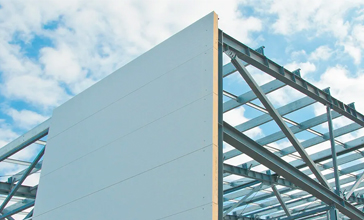
Insulated sandwich panels (ISPs) are a common material used in a wide range of construction including manufacturing, warehousing buildings. Panels have a metal faceplate and backing that sandwiches core-insulating material. This provides buildings with temperature regulation and soundproofing.1
Since the 1970s, they’ve had broad appeal as a material that offers good insulation while being cost-effective, long-lasting, lightweight and relatively low maintenance.
However, the combustibility of some ISP core material is an issue, with multiple significant commercial property fires globally attributed to ISP materials.
Why sandwich panels pose serious risks:
- Highly combustible core – the insulation inside can ignite easily
- Rapid fire spread – once alight, fire spreads quickly up and across, making it difficult to contain
- Toxic gases – burning polystyrene releases thick black smoke and toxic gases
- Structural failure – heat can cause metal facings to separate, speeding up fire spread and causing collapse.
The risk is at the core
QBE Risk Engineer, David Sullivan and Practice Lead – Liability Risk Management, Manchu Mahalingam explain how risks can be managed, and what insurance underwriters look for when assessing buildings containing ISPs.
Insurers will look closely at what type of core materials are in the ISPs.
Sullivan says the main core materials used in Australia are expanded polystyrene (EPS), polyisocyanurate (PIR), modified phenolic hybrid and, to a lesser extent, mineral fibre (these have lower combustibility but are more expensive and offer less insulation).2
“QBE underwriters look for panels that meet FM Global or Loss Prevention Certification Board standards,” Sullivan says.
“For optimal loss prevention, we recommend using panels with non-combustible insulation. For example, mineral fibre, rock wool etc.”
“If panels with a non-combustible core aren’t an option, make sure the ones you choose are certified to FM Approved Class 1 (4880, 4881 or 4882), or approved by the Loss Prevention Certification Board.”
It’s often difficult to identify which core material has been used, just by looking at its exterior faceplate with the naked eye.
Mahalingam says QBE identifies the core combustibility of panels using four main methods: ISP core sampling (lab test), UV identification, logo identification and building/construction documentation. Logo identification may not always be accurate, as the correct logo may not be affixed to the faceplate in the first instance.
To help insurers identify panels, customers should keep all manufacturers’ paperwork and panel model testing data.
Management processes are key
Fires involving combustible ISPs can be intense and hard to control, so it’s important to prevent these fires in the first instance.
There are three main components QBE looks for on sites that have used combustible ISP construction: robust and well documented management controls, the condition of the panels, and management of ignition sources.
Procedures should clearly outline the site’s processes for managing risks.
“Warning signs would be to see damaged panels, allowing the core to become exposed, incorrectly sealed penetrations and areas where panels are removed or have been worked on without an adequate cold work permit,” Sullivan says.
“Monthly documented condition inspections should be conducted of all ISPs, with an emphasis on plant rooms, production and storage areas and confined spaces,” according to Sullivan.
Inception hazard management is crucial: any heat-producing process near ISPs will increase the risk of ignition.
Common ignition sources include:
- Forklift charging units
- Lighting
- Cooking appliances
- Smoking and ‘hot work’ (welding or grinding).
How to handle ISP penetrations
Common examples of ISP penetrations would be cable and conduit runs, duct work and piping. These require slightly different ways of penetrating and sealing.
Sullivan says at the end of each installation the penetration should be sealed with non-combustible material to ensure no foam core is visible. Heat conductive services, such as hot water pipework and exhaust flues installed through combustible ISPs should be protected with a non-combustible insulation.
He says they should also be and inserted through a metal sleeve or collar to keep clearance between the pipe and combustible core.
“When penetrations are made, it’s important to ensure no heat is produced during the cutting process as it may ignite the core material. Ensure cold cutting methods are used on panels for any work, including electrical cabling and pipe penetrations,” Sullivan says.
“Any identified damage or unsealed penetration should be repaired by a qualified contractor, ensuring all visible foam core is capped.
“Also, encourage staff to immediately report any damaged panels or unsealed penetrations.”
Electrical equipment shouldn’t be mounted directly to a combustible foam sandwich panel, or even in the vicinity. This goes for all ignition sources.
If these hazards are on or near the panel, a sheet of fire-resistant material or a thermal barrier should be fitted between the wall or equipment, extending two metres above and to the sides of the equipment. A thermal barrier can delay ignition of insulation and help prevent heat transfer to the combustible core. And that allows enough time for an automatic fire protection system to activate.
Systems for hot and cold work
Lack of adequate controls for hot work is a leading cause of fires in buildings with combustible ISP.
Once the core material has been identified, it’s important to install signage on the panels naming the core type and prohibiting hot work nearby. Clear labelling helps workers identify where hot work is not permitted and where a cold work permit will be required.
A cold work permit system provides a process for reviewing and approving work to be conducted on any ISPs in buildings. The permit should provide a detailed description of work being conducted, the location of the work and who is conducting it.
Permits should only be issued by authorised and trained employees such as maintenance managers.
Before work is signed off, it should be inspected by the permit issuer 30 to 90 minutes after completion with completed permits kept on file.
Replacement, protection and detection
Management risks are complex for sites with significant amounts of combustible panelling, so it makes sense to reduce the presence of high combustibility ISPs.
Sullivan says it’s best practice for procedures to include a panel selection and replacement policy. It should outline a requirement that all future works including repairs, replacements and refurbishments must use an insurer-approved panel.
“A replacement program is a systematic way of minimising the amount of ISP with ‘combustible’ insulation in a building over time.
Contact your insurer to confirm the suitability of any replacement panel.
A well-designed automatic sprinkler system can help to limit the loss expectancy in buildings containing ISP. A fire services consultant and your insurer should be able to advise on sprinkler systems for ISPs.
Other protection and detection methods include installing:
- Private fire hydrants with good coverage and an adequate water supply
- Automated fire detection systems – which can alert the fire brigade quickly and isolate a fire so it doesn’t spread within and between buildings.
Learn more
- Watch webinar: Risk Insight – Insulated sandwich panelling and external finish systems
- Visit QBE Risk Solutions for more risk insights and resources.
1 What is Insulated Sandwich Panel? Sandwich Panel Suppliers | Sandwich Panel Roof Price Melbourne
2 Interview with David Sullivan 13/1/23